Thanks to new technologies, the world of architecture is undergoing a complete transformation BIM modelling represents a new milestone in architectural informatics. In recent years, it has not only
BIM modelling represents a new milestone in architectural informatics. In recent years, it has not only reshaped the work of architectural designers in Hungary, but has also fundamentally transformed construction, technical supervision and building operation processes. CÉH zRt. was among the first to adopt these developments.
Using 3D models created at the required level of detail, it is possible, for example, to virtually test different material solutions extremely quickly already in the preparation phase, or to resize certain areas within minutes. All this comes at a negligible cost compared to implementing changes once a project is already under construction. Although the method has been gaining popularity since the 2000s, BIM is in fact more of a working methodology than software: its foundation is a centrally hosted, shared model of the ongoing project, accessible to all stakeholders.
This three-dimensional, digitally walkable model — which also allows the export of traditional drawings — can be used for preliminary cost estimation, during construction works, and throughout building operation. However, BIM offers much more than that.
One of its most important added functions is clash detection, which clearly identifies potential design conflicts within the building, helping to avoid collisions between different building elements. As a result, planning becomes more reliable and the design package reaches a higher quality level. This helps prevent costly corrections, construction difficulties, or even delays to the planned handover date — issues that become increasingly expensive as construction progresses. Thanks to this methodology, the number of site management hours and design errors can be significantly reduced, the latter potentially even to zero.
BIM also enables data exchange between different design software platforms — typically Archicad and Revit in Hungary. However, fully leveraging these advantages largely depends on the investor or client. While models are an integral part of both design and construction processes, they can also be handed over to the client and populated with any level of detail and content required.
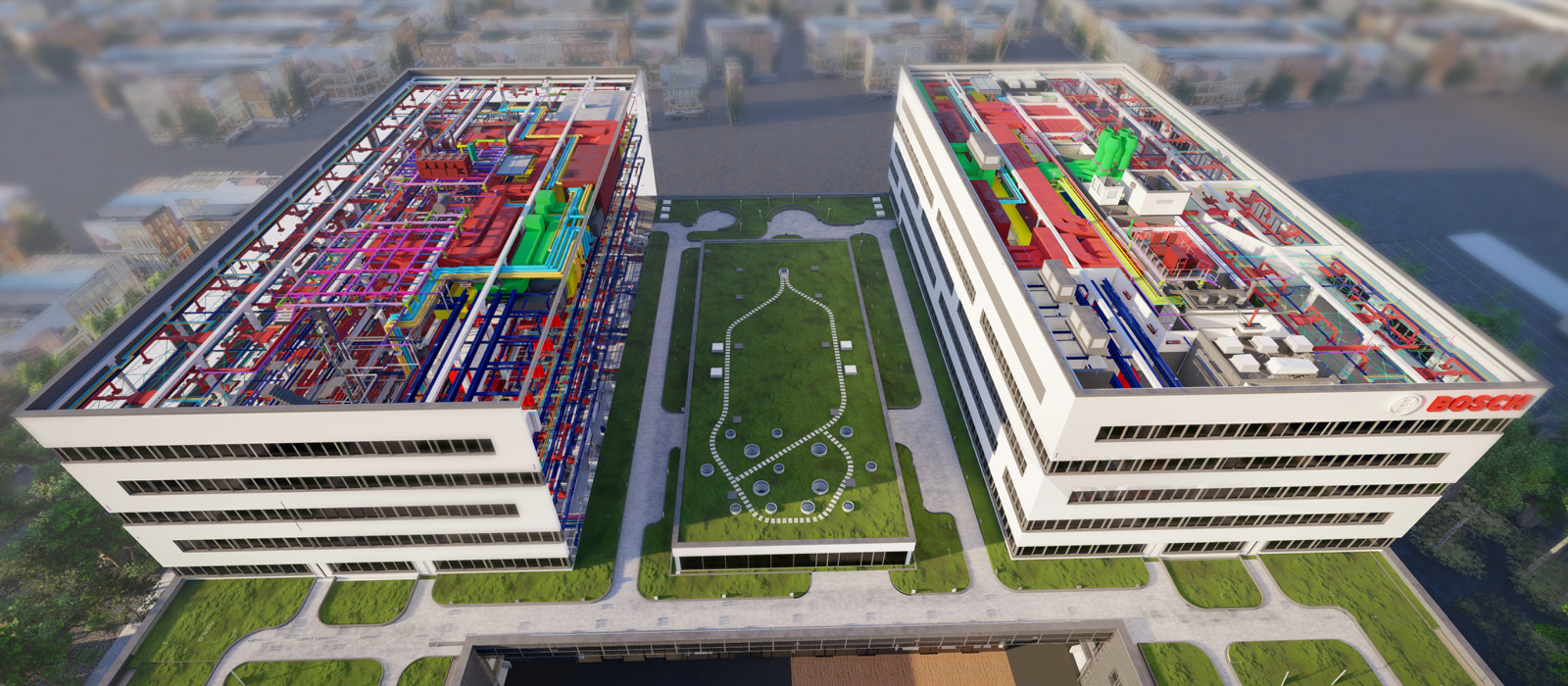
In the case of the Bosch Innovation Campus in Budapest’s 10th district, completed in 2022, the use of BIM was a clear requirement towards CÉH. From the very beginning, it was evident that Bosch intended to use the completed model during operation as well. CÉH’s design team supported this process with a methodological framework — the BIM Execution Plan (BEP) — clearly defining the execution of BIM processes and the conventions applied to the models.
In the case of the BMW plant in Debrecen, CÉH participated as project manager, technical supervisor and as the client’s representative, meaning they also carried out BIM management on the client side. The German automotive manufacturer likewise required continued use of the model, which allowed them to fully define its information content. These options offer a wide range of possibilities: a client may even request that, in addition to performance and dimensions, the warranty expiry date of an air handling unit be recorded in the model.
As-built BIM models rely heavily on importing point clouds generated by laser scanning, enabling regular verification that what has been built truly matches the design approved by the client. In the BMW project, CÉH carried out these audits on a monthly basis, after which contractors had 30 days to correct any discrepancies — until, by the end of construction, the number of deviations was reduced to zero.
Such point-cloud-based surveys are also applicable to existing structures: for example, this method was used during the renovation of the Hungarian State Opera House. In the future, increasingly efficient artificial intelligence tools will further support this work by autonomously and rapidly identifying pipes, windows and other key building elements.
BIM models also provide major support for so-called 4D scheduling, primarily used by contractors. Model elements can be linked to construction schedule tasks, allowing simulations that show how a building will emerge from the ground up. These visualisations are extremely helpful for clients and investors as well, as they convey the essence far more clearly than dozens of drawings. At the same time, planners can assess whether the sequence of construction activities is truly optimal.
Among the most significant innovations are LCA (Life Cycle Assessment) processes, which support sustainability objectives. Despite its appealing name, LCA is a highly complex scientific method for modelling and optimising the environmental impact of a building throughout its entire lifecycle. It takes into account the carbon footprint of construction materials and processes, energy and water consumption during operation, as well as emissions and savings related to demolition and subsequent recycling.
Digital twin technology is just as important. Primarily used in building operation, it involves creating a perfect digital replica of the building, into which data from the real building’s operational systems and sensors is continuously fed. In the background, artificial intelligence analyses this data. Some applications may sound simple at first — for example, automatically reducing ventilation rates or air conditioning output in a meeting room when it is unoccupied.
The range of possibilities is virtually limitless. With a digital twin, systems can also perform “what if?” analyses, assessing the potential impacts of storms or earthquakes, or even proposing solutions in response to a sudden rise in electricity prices.
With decades of experience on the Hungarian market, CÉH zRt.’s expertise in BIM is clearly demonstrated by the fact that in spring 2021 it became the first company in Central and Eastern Europe to obtain the BSI Kitemark certification for ISO 19650-1 & 2. As a result, the company has for years been positioned among Europe’s — and the world’s — leading BIM practitioners.
The article was published on the online platform of 24.hu on December 11, 2025.